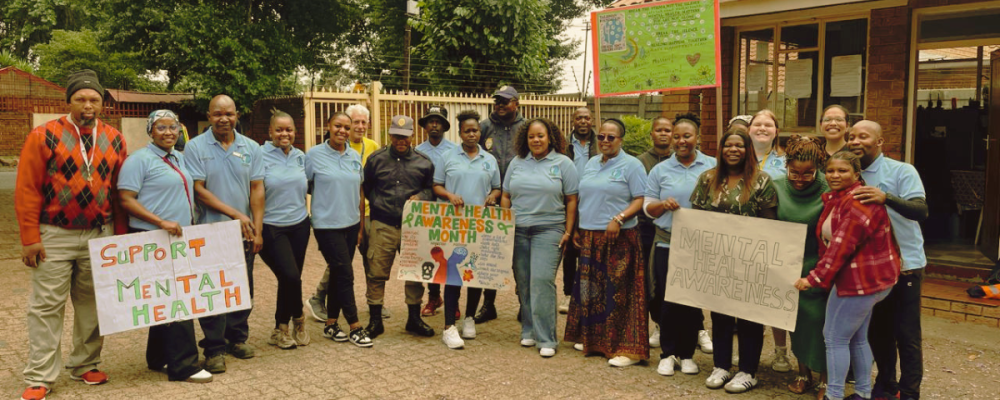
… this is my home. I mean, I don’t really have a home outside of here, I mean, I’ve got family, but that isn’t my home. This is my home.”– *Chris, a resident at The Talisman Foundation
Despite the lessons of the Life Esidimeni tragedy, it has come to light over the past few weeks that another crisis is unfolding in Gauteng. This time, an unfortunate lease termination and the subsequent actions of the Gauteng Department of Health (GDoH) may lead to the closure of The Talisman Foundation in Johannesburg, impacting community-based mental health care in the province.
The similarities between the Life Esidimeni tragedy and the looming Talisman crisis are stark, and yet, we are not entirely surprised that this is happening again. Community-based mental health organisations and services continue to be under-resourced, underfunded, and under-prioritised, despite them being an evidence-based model for expanding access to care, advancing rights, and improving health and social outcomes.
The importance of community-based mental health care
Community-based mental health organisations are non-governmental organisations that provide services outside of institutional settings, as near as possible to where people live, work, or study. These services should be informed by a person-centred recovery model, with an emphasis on psychosocial rehabilitation and promoting overall wellbeing.
The World Health Organisation’s (WHO) Department of Mental Health and Substance Abuse Unit Head, Dr Mark van Ommeren, argues that not only is community-based mental health care more compassionate than an institution, but that it’s a proven model for improving social and health outcomes, advancing human rights, and expanding access to care.
Community mental health care is considered best practice in many countries and is strongly recommended by the WHO. It has several advantages, including providing care close to the places people live and work, reducing the stigma of psychiatric institutions, and facilitating the integration of people living with mental health conditions into their communities.” – Professor Crick Lund (Co-Director, Centre for Global Mental Health, Health Service and Population Research Department, Institute of Psychiatry, Psychology and Neuroscience, King’s College London & Honorary Professor, Alan J Flisher Centre for Public Mental Health, Department of Psychiatry and Mental Health, University of Cape Town)
According to Central Gauteng Mental Health [one of SAFMH’s constituent member organisations], individuals and families depend on community-based care as it provides daily care and supervision, developmental stimulation, behavioural support, rehabilitation and recovery, family support, social inclusion and dignity, while also helping to prevent relapses, neglect, and unnecessary institutionalisation.
Talisman
Talisman endorses our reintegration back into the community. That’s one of their goals”. *John, a resident at Talisman.
The Talisman Foundation is a psychosocial rehabilitation centre that specialises in the long-term care and treatment of people with mental health conditions. For 50 years, it has been a shining example of community-based mental health care, providing essential care and dignity to many mental health care users (MHCUs) who would otherwise not have had a place to call home.
…for me, Talisman is heaven on earth. It is a top-tier psychosocial rehabilitation centre. You will not get better than this. You might get equal. It’s just like a private institution, even though it’s partially government-funded. And they have a fantastic facilitation system where you see your facilitator every month, so you can discuss your situation and what you need from your facilitator. They’re always there for you. Also, they have an unrivalled vocational skills training programme. They call it the ‘VST programme’. And that’s where you can really come into your own here. – *John, a resident at Talisman.
Community-based Mental Health Care vs. Institutionalisation
Long-term mental health institutions, such as psychiatric hospitals and asylums, are frequently marked by limited access to effective treatment, social isolation, inadequate living conditions, resource shortages, and overcrowding. In contrast to this, community-based mental health care, such as the services provided by Talisman, supports access to services and activities of mental health care users’ choosing. By accessing these services, persons with mental health conditions can progress with their recovery and rehabilitation towards a ‘thriving’ state.
Community-based mental health care is far more than an alternative to institutionalisation—it is a model of dignity, inclusion, and empowerment.” – Indlela Mental Health (SAFMH Member Organisation in the Eastern Cape)
WHO also states that community-based mental health care helps people become more included in their community. Zululand Mental Health, another one of SAFMH’s member organisations, argues that, through this model, people are able to maintain social ties and build coping skills as care happens in the community rather than behind the walls of institutions.
Chavonne*, a resident at Talisman, reflects on the difference between institutionalisation and living at Talisman: [referring to institutional settings] “… it’s very inhumane. You have no rights. You are humiliated and degraded, and on an emotional side, it was not healthy […] It was a nightmare compared to Talisman. Talisman has almost all the facilities you want”.
She goes on to list the valuable things that Talisman has: …its own chapel […] a library […] a gym […] our own boardroom […] an entertainment centre with a huge smart TV […] a sewing room […]”. She also highlights the importance of accessible, caring staff: “… there are a few facilitators that live on the premises. So if you need help in the evenings or whatever the case is […] there’s someone there all the time […] This is freedom”.
The Issue of Funding
A study published through Psychiatry Online shows how community-based mental health services can also extend care at a lower cost, fostering deeper involvement within local settings for people who have mental health conditions. Professor Lund agrees with this point, saying that community mental health care is indeed an efficient way of making use of limited resources.
The SA Federation for Mental Health (SAFMH) runs a helpdesk that is dedicated to assisting mental health care users, their families, and members of the public in need of information about mental health services. Since the beginning of April 2025, SAFMH received 51 enquiries from family members seeking accessible, residential facilities across the country.
The need for more community-based mental health care is clear, yet many community-based mental health organisations are experiencing declining government funding. SAFMH President, Professor Sheila Mokoboto-Zwane, notes that the available funding is often irregular (delayed or unpaid), inconsistent (varying in amount and occurring in unpredictable cycles), and inadequate (insufficient to cover the actual cost of services).
In 2019, the National Department of Health commissioned the Mental Health Investment Case Report. The report provided evidence of the economic benefit and improved social value of adequately funding community-based mental health services in South Africa. It also showed that deliberate investment in these services could reduce the long-term costs of institutionalised care, increase accessibility, and improve national development outcomes. But despite this, problems related to government subsidies for community-based mental health services persist.
Repeating The Mistakes of The Past
The National Mental Health Policy Framework (2023-2030) states that the government has committed itself to the provision of adequate and humane community-based mental health care. Yet, the Talisman Foundation faces closure, and its residents face losing their sense of community and home.
It is a profoundly sad day when the government chooses to close such facilities rather than strengthen and sustain what has already been built by communities themselves. These structures embody dignity, care, and the promise of community.” – Bharti Patel, Executive Director at SAFMH.
Despite global guidance regarding the movement of mental health care users and useful examples of successful interventions, the GDoH has continued with its rushed and unclear proposed relocation plan.
…the way that they’ve (GDoH) managed this process has actually been quite shocking. We’ve been treated as patients by them, not as individuals and as people that are worthy of being taken properly care of. I mean, they tied Talisman’s hands and we weren’t even communicated [with]. We were suddenly being questioned by doctors and psychologists who didn’t know what the heck was going on, but Talisman’s hands were closed. They should have, right up front, come and communicated with us and done that whole process properly. It’s just been rushed and very ineffectively managed.” – *Chris, a resident at Talisman Foundation
SAFMH, in partnership with Section 27, SADAG, and The Talisman Foundation, are working hard to address the Talisman crisis, which, unfortunately, is not a single, unique case in Gauteng. Poor collaboration between the government and providers of community-based mental health care is generally the norm and not the exception to the rule across South Africa. We therefore need the government to urgently come to the table and start meaningfully engaging with and funding community-based mental health care across South Africa. Here in Gauteng, we need the GDoH to act in the interests of the mental health care users of Talisman who risk displacement and all the other problems that transpired during the Life Esidimeni tragedy. We cannot allow this to happen.
Now is the time to recognise that mental health care belongs in communities, where people can find a sense of community, build resilience, and gain hope.
Talisman is raising funds to secure new premises. You can donate directly to their BackaBuddy here.
*Names have been changed to protect privacy
For enquiries and more information, please contact:
Michel’le Donnelly – Communications and Awareness Lead
Email: michel’le@safmh.org
Cell: 0797996533