The 30th of March 2026 marks World Bipolar Awareness Day.
Commemorated annually, the day is a chance to raise awareness and challenge stigma around bipolar disorder.
This year, the SA Federation for Mental Health is sharing a personal essay written by Michela Thorns. Michela is a person with lived experience and a member of the SAFHM National Youth Advocacy and Advisory Forum. We are thankful to Michela for sharing her story so boldly and honestly.
How it all began
I began feeling depressed at 15 years old. I felt like a truck had hit me. I was depleted, bedridden, numb, and in physical pain. A year later, at 16, I felt I could not keep clinging on for dear life in secret. I knew that if I did not get help, I would not be able to go on for much longer. I was able to see a psychiatrist, and I was prescribed a low dose of an antidepressant. Around the same time, I had started engaging in self-harm, and I began having spurts of energy where I did not feel the need to sleep. I had lots of ideas that I thought were genius, and I felt like I was on top of the world.
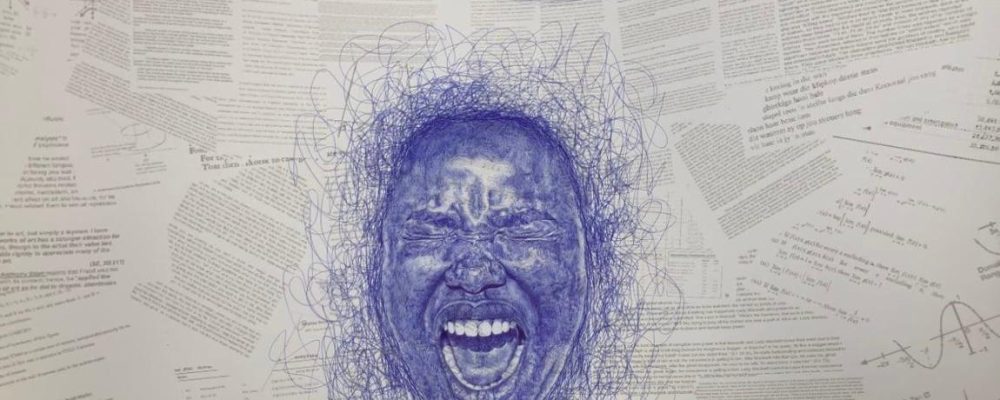
At first, these episodes were few and far between, interwoven with long periods of depression. However, they became more frequent and lasted for longer periods. What I now know to have been hypomanic episodes had become my productive state. I was creating amazing art that received great feedback from everyone who saw it. Unfortunately, this encouraged me to enjoy the mania—I was creating masterpieces with BIC pens in three days, sleeping only about 3 hours per night. This was very indicative of my mental state at the time. I did not want to tell my therapist and psychiatrist about these episodes because I knew they were responsible for the peak of my artistic abilities; hypomania felt like my superpower.
As time went on, the episodes became more detrimental to me, and I began feeling truly insane. I feared that if I were honest with my psychologist and psychiatrist, they would lock me up in an asylum and throw away the key. However, after my mom discovered my self-harm, she “outed” me to my psychologist and psychiatrist. They came up with a preliminary diagnosis of rapid cycling Bipolar II, and put me on a mood stabiliser to see if it would help.
Depressive episodes persisted. One of these episodes came with self-harm and suicidal ideation, and I was hospitalised for three weeks—two months shy of my eighteenth birthday. Leading up to this, I was staying home from school, and my parents had to take time off work to monitor me throughout the day. My weekly therapy and medication at the time were not keeping me afloat. Not only was my mental health affecting me, but it was also taking a toll on my family, and it was not fair for them to be in that situation.
I felt ready to get better, and I knew I had to do it in a place where I couldn’t be a risk to myself and where recovery was the only thing I had to focus on. While in hospital, my external psychiatrist, psychologist, and in-hospital psychiatrist came together to finalise a diagnosis of Bipolar II.
Relief
After being confused about what was happening to me for such a long time, my diagnosis came with a strange sense of peace. One would not think that a diagnosis of a serious mental health condition could bring someone serenity, but that is exactly what I felt. I realised that my experience was not so unique. I felt kind of “normal” knowing that others had this disorder. I now knew I wasn’t as “crazy” as I thought I was.
Receiving a diagnosis meant finally putting a name to the problem, allowing a proven solution to be implemented: a treatment plan. With my diagnosis, mental health professionals understood how to address what was happening in my mind, which medications to consider, and which therapeutic techniques were most likely to help.
Identity Crisis
Once my treatment plan was in effect, I started struggling to know if I could separate myself from this disorder, or where that separation would begin. I began deconstructing my life experience, thoughts, and feelings up until that point. Once correctly medicated with mood stabilisers, I became acquainted with what a healthy baseline looked like. The problem was that I could not decipher between my illness, particularly the hypomania, and my personality.
I asked myself questions like: “Am I really creative, or am I just having the flight of ideas that comes with hypomania?” “Am I ever really productive, or am I just on manic autopilot?” “Is anything I make actually good, or am I delusional?” And the scariest question of all at the time: “If I am in treatment, will I ever produce good creative work again?”
I wondered if I was my disorder, and what my disorder said about me.
Uncertainty
Naturally, an identity crisis and a new diagnosis came with many feelings of uncertainty. As relieved as I was to have answers, being diagnosed with a chronic mental illness at 17 felt like a life sentence. If I still had up to three-quarters of my life left to live, I had no idea what those details would look like. All I knew was that psychologists, psychiatrists, frequent check-up appointments, medications, blood tests and hospital admissions were etched into my future.
Shame
For the most part, I have felt unashamed of my diagnosis. The clarity that the label brought to my life strangely felt like a gift, and I knew that I would have continued to spiral without it. Yet, as I became stable and my illness was no longer all-encompassing, it sank in that people in my life would find out about my diagnosis.
Once my diagnosis was no longer something so central in just my life, it began to escape the confines I had tried to put around it. As much as I knew about myself, my experiences, and my conceptualisation of Bipolar Disorder, I could not control what others thought of it.
Many people think that Bipolar Disorder is characterised by sudden, dramatic mood swings, comparable to grumpy teachers or the weather. I felt like people knew what anxiety and depression were, but more complex conditions still carried heavy stigma. I worried that if people found out I had Bipolar Disorder, they would label me as a “crazy person,” or someone who regularly flies off the rails.
My treatment plan
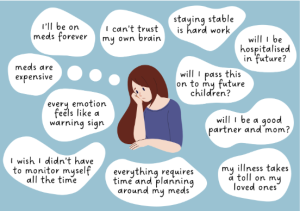
I know that to remain stable, I have to adhere to a routine. I need to ideally get eight hours of sleep each night, take my medication twice a day, 12 hours apart, make sure I’m eating three meals a day, and keep alcohol consumption to a minimum. As much as most of these guidelines should be followed by everyone, they are non-negotiable for me.
This strict routine inhibits my life in a variety of ways. For example, having to be in bed at a reasonable time and not drinking a lot alters the social gatherings I take part in. There are also lifelong restrictions, like not being able to travel abroad for extended periods because I will need to fetch new medication every month, forever.
Grief
Since receiving my diagnosis, the feeling of deep grief has felt the most severe. It often feels never-ending, like a miserable companion that frequently rears its ugly head when it pleases, along this already long and treacherous journey. It’s really odd to grieve something you’ve never known. I can picture a life that contains things that are unsustainable for me to have—things that would be detrimental to my mental health, and I often find myself mourning the mere concept of that spontaneous life.
I’ve had to grieve a life I have never lived, a life of spontaneity that I can’t have if I choose to stick with recovery. Having to reckon with these things in my early twenties, at the start of my adulthood, still feels brutal.
Acceptance
Despite the grief, I have had to accept that parts of my life will always be different from most people’s—past, present, and future. I still feel like the cards I’ve been dealt are unfair, and now and again, I still allow myself to sulk about it. But, as I have gotten older and lived more of my life stably, I have come to recognise that my life is not the only one with limits and hardships.
Although many people who don’t know my history may think I’m lame and do not understand the necessary life alterations my diagnosis comes with, I know that if I want to continue to live the stable, rich life I have now, I have to accept the parts of life that my diagnosis brings with it.
Hope
Over time, learning about and coming to terms with my diagnosis means that I know which parts of myself are me and which parts are my mental illness. I am better at differentiating emotions from symptoms; I know that sadness can exist without depression, boredom without anhedonia, tiredness without exhaustion, happiness without hypomania, inspiration without frenzy, and confidence without delusion. Every time I feel these emotions, I am grateful, because I know that feeling them shows that I am still stable, and my feelings can be more than just indications of my illness acting up.
The life that I know now is full, abundant, and so fulfilling. Most importantly, my journey from being severely ill to well-recovered has taught me that if things get bad again, which they probably will, recovery is always possible, even though it’s hard.
*Disclaimer: I understand that terms get used interchangeably when referring to mental health conditions. My personal preference is to use the term “mental illness” when speaking about myself, but I understand that others may refer to it as “mental health conditions” or “mental health disorders.”
Make sure to subscribe to Michela’s Substack here. You can also follow her on Instagram here.
Check out SADAG’s World Bipolar Awareness Toolkit here.