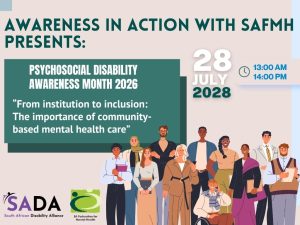
Psychosocial Disability Awareness Month (PDAM) is celebrated annually in July. For 2026, the SA Federation for Mental Health (SAFMH) will be focusing on the theme “From institution to inclusion: The importance of community-based mental health care”, with the aim of emphasising the need to prioritise and increase investment in community-based mental health care, and to highlight how it fosters meaningful inclusion and integration for persons with PD.
Persons with psychosocial disabilities (PD) can face many barriers to community inclusion because of their disability. Barriers may include stigma, discrimination, access to education, employment, and social benefits. These barriers can disrupt their relationships and their ability to socialise and partake in everyday community life.
Community-based mental health care helps persons with PD live and become more included in the community by promoting their involvement to participate in decision-making, facilitating family reunification for persons with PD to be reconnected to their families, and offering interventions designed specifically to allow persons with PD to create links and positive relationships within the community.
The World Health Organisation’s (WHO) Department of Mental Health and Substance Abuse Unit Head, Dr Mark van Ommeren, argues that not only is community-based mental health care more compassionate than an institution, but that it is a proven model for improving social and health outcomes, advancing human rights, and expanding access to care.
Prof Crick Lund (Co-Director, Centre for Global Mental Health, Health Service and Population Research Department, Institute of Psychiatry, Psychology and Neuroscience, King’s College London & Honorary Professor, Alan J Flisher Centre for Public Mental Health, Department of Psychiatry and Mental Health, University of Cape Town) states that:
Community mental health care is considered best practice in many countries and is strongly recommended by the WHO. It has several advantages, including providing care close to the places people live and work, reducing the stigma of psychiatric institutions, and facilitating the integration of people living with mental health conditions into their communities.”
Chavonne*, a resident at the Talisman Foundation, a community-based mental health care organisation based in Johannesburg, reflects on the difference between institutionalisation and living at Talisman: [referring to institutional settings]
“… it’s very inhumane. You have no rights. You are humiliated and degraded, and on an emotional side, it was not healthy […] It was a nightmare compared to Talisman. Talisman has almost all the facilities you want”.
She goes on to list the valuable things that Talisman has: …its own chapel […] a library […] a gym […] our own boardroom […] an entertainment centre with a huge smart TV […] a sewing room […]”. She also highlights the importance of accessible, caring staff: “… there are a few facilitators that live on the premises. So if you need help in the evenings or whatever the case is […] there’s someone there all the time […] This is freedom”.
In 2019, the National Department of Health commissioned the Mental Health Investment Case Report. The report provided evidence of the economic benefit and improved social value of adequately funding community-based mental health services in South Africa. It also showed that deliberate investment in these services could reduce the long-term costs of institutionalised care, increase accessibility, and improve national development outcomes. Despite this, many community-based mental health organisations are experiencing declining government funding.
Professor Sheila Mokoboto-Zwane, president of the SA Federation for Mental Health (SAFMH), notes that funding that is available is often irregular (delayed or unpaid), inconsistent (varying in amount and occurring in unpredictable cycles), and inadequate (insufficient to cover the actual cost of services).
SAFMH recognises that South Africa has a good mental health policy and a good Mental Health Care Act. However, for these to be truly effective, implementation must be prioritised across all provinces and at all levels. Action needs to extend beyond promises, commitments, and talk of there being “political will”. Finances and resources need to start flowing into community-based mental health care as a matter of extreme urgency, in line with global recommendations.
Read more about our campaign here.
We hope that this year’s PDAM campaign will show that now is the time to recognise that community-based mental health care fosters inclusion, expands access, and supports every person’s right to belong and thrive. It can no longer be an optional, “nice to have” alternative to institutionalised care. It should be THE model that all stakeholders and role-players jointly work towards establishing far and wide across South Africa, thus moving away from the more traditional, medical model of care, towards a more human rights and person-centred approach to mental health care.
Community mental health should be at the heart of the mental health landscape in South Africa, and as such, this PDAM, we call on:
- The media to highlight the work of at least one community-based mental health organisation working to foster inclusion in their community. We also ask that when they produce stories about mental health and persons with PD, they make use of the SA Federation for Mental Health’s Positive Mental Health Photo Library, which captures the heart of community-based mental health care, instead of using generic stock images. The photo library can be found here, and the photographs are free to download.
- The public to find out more about their nearest community-based mental health care organisation and see how they can support the organisations’ work.
- The South African government to ensure they carry out the objectives set out in the Mental Health Policy Framework and Action Plan 2023-2030, with a specific focus on helping to cultivate more community-based mental health care across South Africa through increased investment and more effective partnerships with NGOs that provide such services. We also challenge entire government departments (including senior officials) to visit community-based mental health organisations and to see firsthand the need for greater support. For help connecting with such an organisation, SAFMH can assist.
During the campaign, we will also be highlighting the voices of persons with psychosocial disabilities and sharing their experiences of community-based mental health care.
For media enquiries, please contact:
Michel’le Donnelly: Communications and Awareness Lead
079 799 6533 | michel’le@safmh.org