In September 2025, history will be made: the United Nations will host its first-ever high-level meeting dedicated to mental health. It’s a moment that has been years in the making, driven by tireless advocacy from all corners of the world, with a clear message ringing loud and clear: mental health is a global priority.
The meeting in September, titled The Fourth UN High-Level Meeting on the Prevention and Control of Noncommunicable Diseases (NCDs) and the Promotion of Mental Health, may sound like a bit of a mouthful, but it signals something very powerful. World leaders will gather to commit to a political declaration — a shared (though not legally binding) agreement to prioritise mental health and NCDs in their national health agendas.
But here’s something I didn’t realise at first: what goes into that declaration is decided on months in advance — this means right now!
Behind the scenes: how a declaration is made
Before countries sign the final political declaration on NCDs and mental health, there’s a long and intricate process of consultations, drafts and negotiations. The Global Mental Health Action Network (GMHAN) maps this out excellently in their advocacy roadmap, which helped me (and I am sure many others) understand how to engage meaningfully along the way.
One of the major milestones in this process is the UN multi-stakeholder hearing, where mental health advocates — like myself — can apply for accreditation to go to a special meeting at the UN, with the hope of sharing insights and recommendations for what should be included in the political declaration.
Thanks to the support and funding of GMHAN and United for Global Mental Health — and their ongoing commitment to strengthening national mental health organisations — I had the opportunity to represent the South African Federation for Mental Health (SAFMH) in New York.
As part of GMHAN’s Short-Term Action Group (STAG) on NCDs and Mental Health — a network of 40 advocates from 30 countries — I went to New York for a week to attend the UN multi-stakeholder hearing, participate in several side events, and tried my absolute best to meet with South Africa’s UN Mission (keep reading to find out if I was successful!)
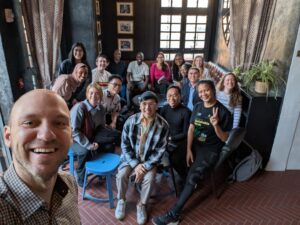
Members of GMHAN’s short-term action group (STAG) on NCDs and Mental Health at a planning meeting in New York
Our priority areas
Before heading into the week, THE STAG identified five core advocacy priorities that the STAG would want to see reflected in the wording of the political declaration. These were:
- Address the social and commercial determinants of mental and physical health by regulating industries that harm well-being.
- Decriminalise and prevent suicide through urgent policy reforms.
- Support young people’s mental health and wellbeing.
- Invest in community-based mental health care and move away from institutionalisation.
- Ensure ongoing, formal involvement of people with lived experience in policymaking at all levels.
These priorities emerged from gathering information from persons with lived experience, from local challenges, and a shared vision for a more inclusive global mental health system. Point four — investing in community-based care — particularly resonated with SAFMH’s advocacy focus, and I made sure to bring it up in all my engagements.
You can read more about the rationale for why these priority areas were selected here.
What the week looked like: learning, connecting, and showing up
Monday:
The week kicked off with an advocacy workshop at the Child Mind Institute, which covered a broad range of topics, ranging from UN structures and nomenclature, to best practices in advocacy approaches.
It was the first time I had engaged in-person in advocacy at a global level for mental health and at the UN-level — and I was deeply grateful for the support and insights shared by the group.
I found the sessions on mapping out your advocacy journey and identifying which priority areas need more traction and how to make that happen incredibly valuable, and can see that the learnings gained have already begun to shape my thinking and practice in approaching my advocacy work back home. Similarly, some of the practical tips on engaging with UN country missions are tools I can apply directly to engaging with our national-level decision-makers back in South Africa.
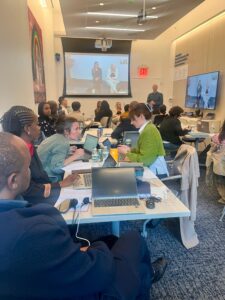
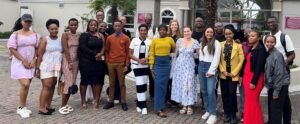
Attendees at Monday’s workshop
Tuesday – Thursday
The key goal for these days was to secure a meeting with South Africa’s UN Mission — our country’s diplomatic team to the UN. The idea was to have a meeting to share with them what SAFMH’s and the NCD Alliance South Africa priorities are and what we hoped would be taken into consideration when South Africa reviewed the draft of the political declaration and entered into negotiations with other country states. Colleagues from the NCD Alliance South Africa and I made it our mission to try and make this meeting happen.
This is also a good moment to highlight that the upcoming High-Level Meeting addresses both mental health and noncommunicable diseases (NCDs), recognising how deeply interconnected the two are. This link is also reflected in our national context — South Africa’s National Strategic Plan for the Prevention and Control of NCDs (2022–2027) includes mental health as a key focus area. That’s why it was so valuable to collaborate with representatives from the NCD Alliance South Africa, including Kwanele Asante-Shongwe (Legal Counsel, NCDASA) and Elize Joubert (CEO of CANSA). Together, we coordinated our key messages and aligned our advocacy priorities to strengthen our case.
While working to arrange the meeting, I also had the privilege of participating in two high-level roundtables:
The first at New York University (NYU) on Integrated Care for NCDs and Mental Health. It brought together academics, UN country representatives, the American Psychological Association, and UNICEF. I had the opportunity to share three small but practical ways mental health and NCD priorities can align, based on South Africa’s policy context:
- Including people with lived experience of NCDs and mental health conditions in disaster response planning.
- Ensuring access to psychotropic medication and non-medical mental health interventions within universal health coverage schemes.
- Addressing alcohol misuse through targeted public awareness campaigns.
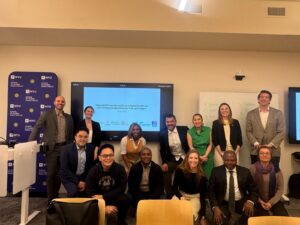
Attendees at NYU’s roundtable on integrated care
The second was with the European Union Delegation, where I emphasised the urgent need to invest in and scale up quality, rights-based community mental health care before pursuing deinstitutionalisation — drawing on the hard lessons learned from South Africa’s Life Esidimeni tragedy. By now, time was running out, and the all-important question remained … Were we able to secure that meeting with our South African representatives?
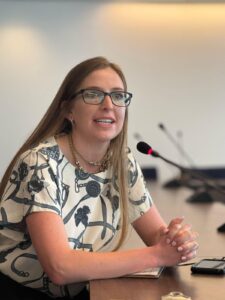
Shayni speaking at the EU Delegation to the UN roundtable
“Home Away from Home”: Meeting with the South African Mission
YES. This was the highlight of my time away. We were fortunately granted a 30-minute meeting, which ended up being 1.5 hours, which I think was a clear reflection on how productive and meaningful the conversations were. We were welcomed into the offices by Silas Sekonyana, the First Secretary: South Africa’s Mission to the UN, describing it as “home away from home”.
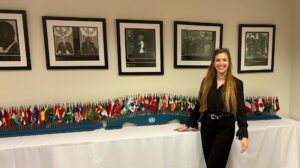
At our “home away from home” – South Africa’s mission to the UN Offices in New York
The meeting reminded me of everything I love about South Africa: warmth, sincerity, and heart.
As a mental health advocate, it’s not something I take for granted to be heard, respected, and engaged with in such a meaningful way. Our meeting was with the Deputy Permanent Representative Marthinus CJ Van Schalkwyk, and First Secretary Silas Sekonyana, and the conversation was rich. We discussed all five of the key priorities STAG had identified and connected them to the domestic context. This included conversations on access to medication, properly using the allocated funding for NCDs (in recent years, there had been a return to treasury of the underspend, when there should not have been an underspend at all), and investment in community-based mental health care.
I felt truly heard, respected, and energised by the commitment they showed, and I look forward to continuing the discussions on this back home.

The absolute highlight: meeting with the South African Mission to the UN, from left to right: KWANELE ASANTE-Shongwe (NCDA South Africa), Silas Sekonyana (First Secretary: UN Mission to South Africa), Marthinus Van Schalkwyk (Deputy Permanent Representative: UN Mission to South Africa), Elize Joubert (CANSA CEO), and myself. Dr Rufaro Mushonga (African Union), who also attended the meeting to provide a regional perspective, also snapped the pic.
Friday: The Big Day at the UN
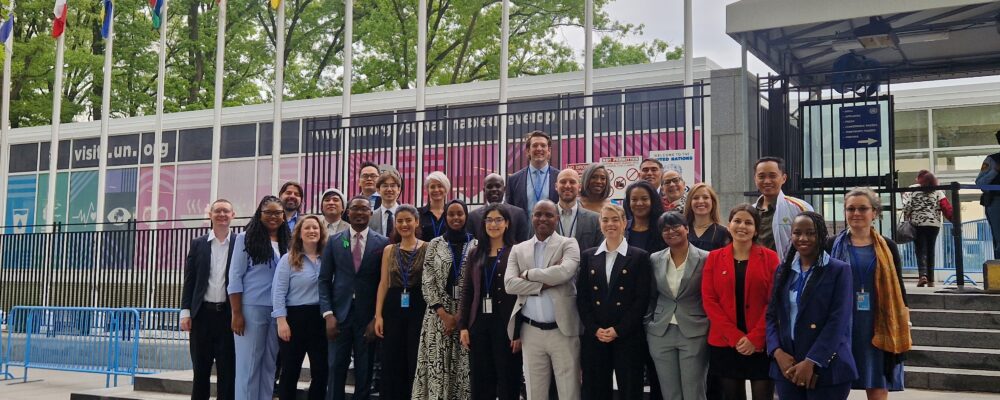
Finally, it was time for the multi-stakeholder hearing.
Walking into the UN headquarters, I was greeted by a statue of our very own Nelson Mandela. I couldn’t imagine a more fitting figure to welcome us, representing all that the UN should stand for: embracing humanity for a more equitable world for all.
While I was sadly not selected to present my statement on the day (you are randomly selected through a lottery system), my voice was very much there through the shared stories and perspectives of the members of our STAG, who were fortunately selected to present.
The statement I prepared focused mainly on community-based mental health, a deeply personal and national issue for us in South Africa, particularly in the aftermath of Life Esidimeni. I wrote about how we need to ensure that services are available where people live, work, and play. This means delivering services within our communities.
My statement also provided some tangible examples of community-based mental health services, such as peer support interventions, mental health promotion initiatives, residential care, and employment opportunities for individuals who are unable to work in the open labour market.. These services are more rights-based and cost-effective than institutionalised care.
I also dedicated my statement in memory of Dr Vicki Pinkney-Atkinson, a South African NCD advocate who fought relentlessly for improving the well-being of people living with NCDs in South Africa and who sadly passed away in 2024.
You can watch the full recording of the 15 mental health interventions below.
So… What’s Next?
Now we wait for the “zero draft” of the political declaration, expected during the week of the 12th of May 2025. This will give us a first glimpse into what was included and whether our collective voices made it into the text. After that, there will be a brief window where countries can negotiate and provide feedback — and yes, we’ll be advocating all the way through.
Then, all eyes will turn to September’s High-Level Meeting, a landmark moment for mental health worldwide.
Final Thoughts
Being part of this process has been emotional, empowering, and full of learning. I’m immensely grateful to SAFMH, GMHAN, and United for Global Mental Health for making this possible.
If the week in New York taught me anything, it’s that being involved in shifting global discourse can make me a better national mental health advocate.
By Shayni Geffen, SAFMH Advocacy Lead
—————————————————————————————————————————————————————————————————
Keep an eye out for our social media platforms for more updates about the upcoming High-Level meeting.
➡️Read more about the NCD and Mental Health Political Declaration and key advocacy priorities here.